The Carry Trade We Killed in an Hour, Using Only the Broker's Own Swap Table
Before writing a line of code for a carry strategy, we read IC Markets' real swap rates for eight candidate pairs. The broker's cut shaved the fat interest gaps down to pennies, and the fattest pair of all is one you are not allowed to open.
The carry trade is the oldest idea in currencies. Hold a currency that pays a high interest rate, fund it by borrowing one that pays a low rate, and pocket the gap every night. In theory the high-rate currency should weaken enough to cancel the gap. In practice it usually does not, so the gap keeps arriving. That leftover is the edge, and you are not being clever to collect it. You are being paid to hold a risk nobody else wants: most days the trade drips out small, steady profits, and every few years a panic sends everyone out of the high-rate currencies at once and it drops hard. Pennies in front of a steamroller, as the saying goes.
There is a catch that kills the whole thing for retail traders, and it has nothing to do with the theory. In MetaTrader your broker pays you that interest gap through a nightly swap credit, and the broker shaves it. Usually it charges more on the side you borrow than it pays on the side you hold. So the interest you actually receive can be tiny, or negative, even when the textbook gap looks juicy. Which means the first thing to do is not to code anything. It is to open the broker's own swap table and read the real numbers. One hour of checking beats a month of building.
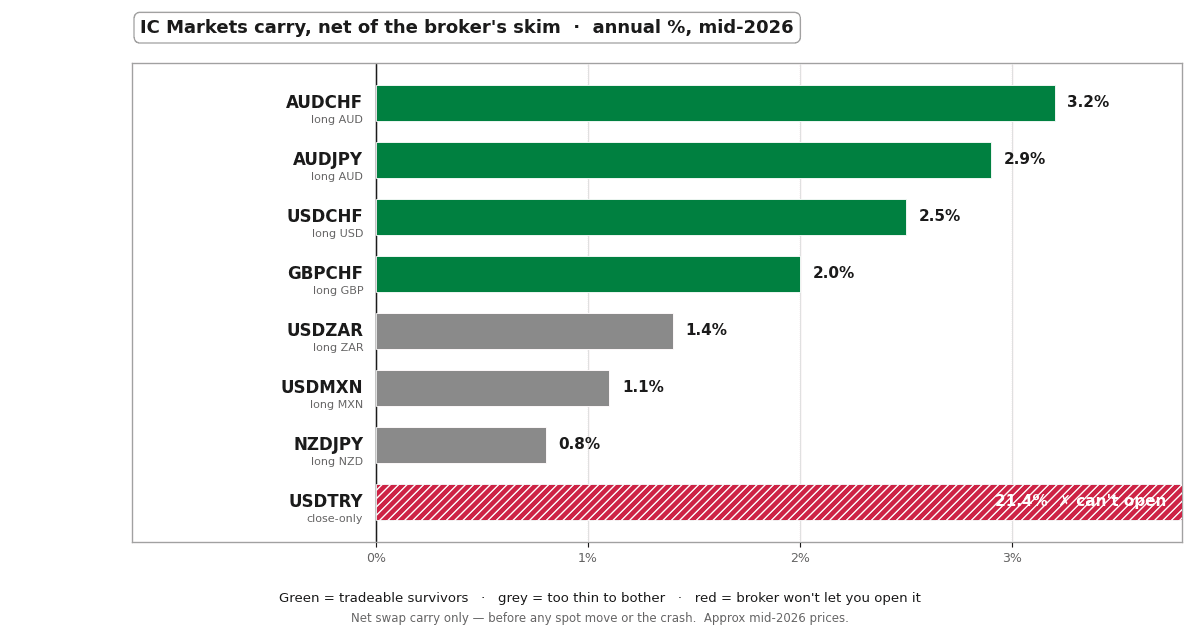
So that is what we did. We opened the IC Markets swap specification for eight carry candidates and worked out what each one actually pays after the broker's cut. No EA, no backtest, no data download. Here is the whole result.
Eight pairs, net of the broker's cut
| Pair | Carry direction | Net carry, %/yr | Read |
|---|---|---|---|
| AUDCHF | long AUD | 3.2% | best survivor |
| AUDJPY | long AUD | 2.9% | shrinking as Japan hikes |
| USDCHF | long USD | 2.5% | clean |
| GBPCHF | long GBP | 2.0% | worst skim of the survivors |
| USDZAR | long ZAR (short USD) | 1.4% | too thin |
| USDMXN | long MXN (short USD) | 1.1% | too thin |
| NZDJPY | long NZD | 0.8% | dead |
| USDTRY | long TRY (short USD) | 21.4% | close-only, cannot open |
These are gross carry figures: the swap income only, before the currency moves a single pip and before the crash. Prices are approximate mid-2026 levels, but the swaps are exact off the broker's table, and the ranking does not move with a few percent of price error.
The skim, made concrete
Look at USDMXN. The Mexican peso is a genuine high yielder, and the raw interest gap over the dollar is roughly five percent a year. To collect it you want to be long the peso, which means short USDMXN. The broker pays you 54.8 points a night for that. On the other side, to be long the dollar against the peso, it charges you 244.1 points. That gap between the two sides is the broker's cut, and it is enormous. After it, the five percent gap arrives in your account as 1.1 percent. The broker keeps roughly three quarters of the carry. USDZAR tells the same story at 1.4 percent. The fat emerging-market gaps everyone chases are real, and the broker eats almost all of them.
NZDJPY was a staple carry pair for a generation. Now that Japan is finally raising rates, the gap has closed to almost nothing, and after the cut it pays 0.8 percent a year. Dead. You would have found that out in the time it takes to open one window.
The survivors are secretly one trade
Four pairs clear a respectable two to three percent: AUDCHF, AUDJPY, USDCHF and GBPCHF. Before getting excited, notice what they have in common. Every one of them is funded by a safe haven, the Swiss franc or the Japanese yen. AUDCHF, USDCHF and GBPCHF are all short the franc. That means they are not four independent bets. They are one bet wearing four tickets, and it is the classic carry bet: nothing bad happens. The day a panic hits, the franc and the yen are exactly where the frightened money runs, and all four positions lose together. The steady two to three percent a year is the fee you collect for wearing that single hidden risk. AUDJPY has a second problem on top: its carry is actively shrinking as the Bank of Japan lifts rates, so the number in the table is melting while you read it.
The fattest carry is the one you cannot have
USDTRY sits at the bottom of the chart in red for a reason. On paper it pays 21.4 percent a year, by far the fattest carry on the board. IC Markets has it set to close-only: you are allowed to close an existing position, but you cannot open a new one. The broker will not let you get on the road in front of that steamroller. And even if it did, the lira has been falling something like twenty to thirty percent a year, which quietly cancels the 21 percent carry on the spot leg. So the fattest carry on the whole list is the one pair you are not allowed to place.
What the hour bought us
The screen answered the only question that mattered. On IC Markets, realistic carry tops out around three percent a year, on a handful of pairs that are all the same risk-off bet, with the one genuinely fat opportunity locked out of reach. That is not a foundation for a systematic strategy. It is a thin, crash-shaped premium sitting behind the broker's cut.
There is a second reason we stopped before coding. A carry backtest is uniquely hard to do honestly, because the strategy tester applies a single fixed swap value across the whole history, and for a carry trade the swap is the entire profit. The franc was a negative-rate funder until 2022, then the Swiss central bank hiked, then cut again. Freezing today's swap across seven years of that would be fiction. An honest test needs a swap that changes with the interest rate history, coded by hand, which is the month of work the one-hour check exists to save you from.
We have been here before. The last carry idea we actually built, the Wednesday triple-swap trade, collected its carry exactly on schedule every single week and still lost a fifth of the account, because the price leg swamped the income. This time the swap table told us the same ending before we wrote a line. The carry is real. It is also, after the broker has taken its share, not worth the risk of holding it. Checking took an hour. The hard part is trusting that answer and not building the thing anyway.